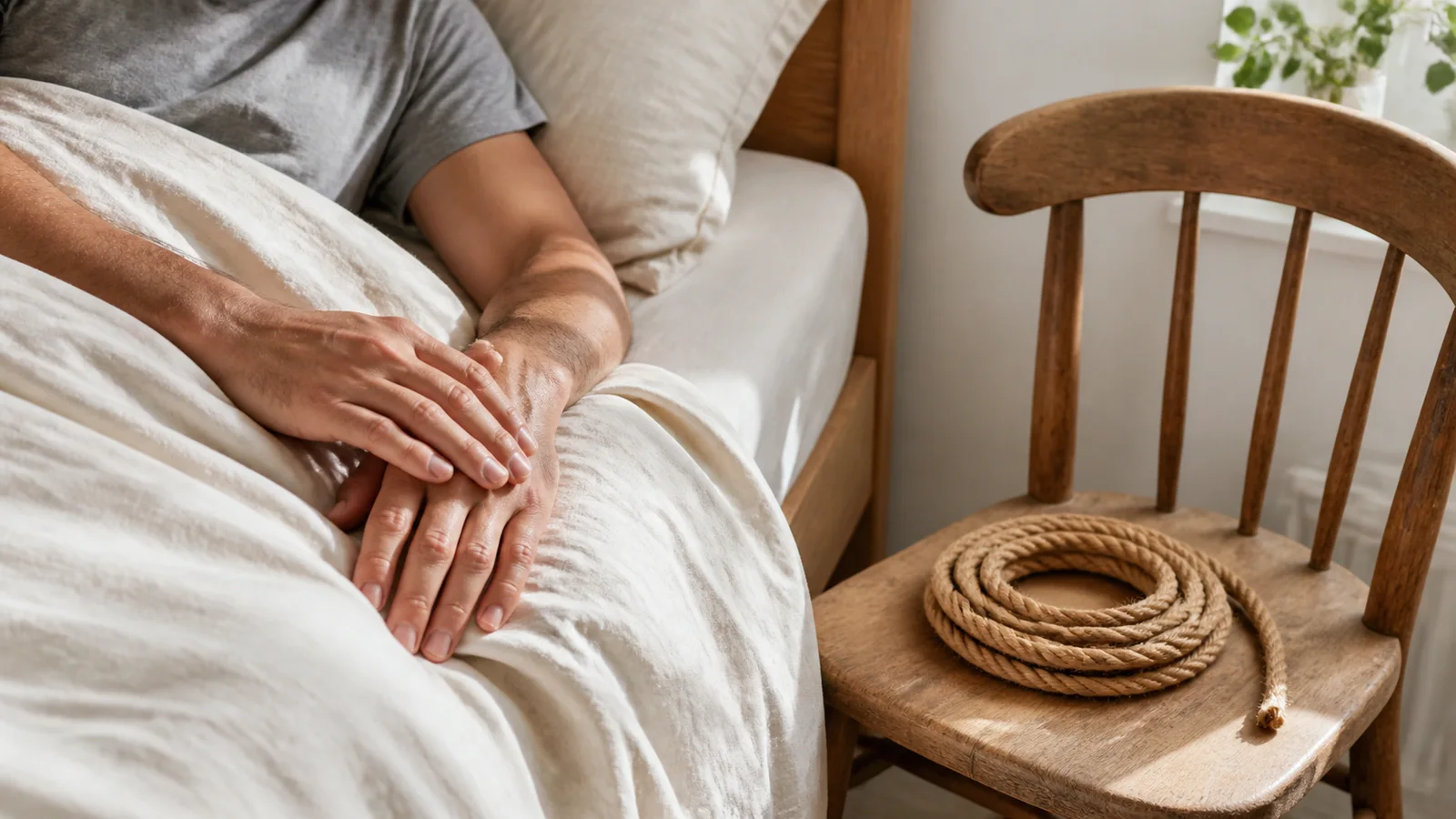
The rope is a movement cue, not a visual test
The rope technique involves imagining that you are climbing an invisible rope suspended above the body. The aim is to create the felt sense of movement without moving the physical arms. It became widely known through the work of astral projection author Robert Bruce.
You do not need to see a rope. Tactile imagination is more important: the texture in the hands, one hand moving above the other, and the feeling of the upper body being drawn upward.
Begin after the body has become quiet
Settle near sleep first. The body should feel heavy, distant or easy to ignore. Starting the climb while fully awake usually creates mental strain and an urge to move the real muscles.
Early morning or after a spontaneous awakening can make the method easier. If vibrations or floating sensations are already present, begin calmly rather than waiting for a more dramatic signal.
How to perform the movement
Imagine reaching with one non-physical hand and gripping the rope. Feel the pull in awareness, then place the other hand higher. Continue at a steady pace. Keep the jaw, shoulders and physical fingers relaxed.
Let the imagined action occupy most of your attention. If you find yourself watching a picture of someone climbing, return to the first-person sensation of doing it yourself.
What you may notice
The sense of upward movement may strengthen, vibrations may increase or the physical body may disappear from attention. Sometimes the scene changes suddenly and no clear separation moment occurs.
If nothing develops after a short, focused attempt, release the exercise and return to relaxed observation. Repeating it with increasing force usually wakes the body rather than improving the transition.
The most common mistakes
People often begin too early, tense the muscles, try to produce a perfect visual image or keep checking whether the technique is working. Each mistake redirects attention to the waking body.
Another mistake is treating the rope as compulsory. It suits people with strong tactile or movement imagination. If it feels artificial after several well-timed attempts, choose a roll, sit-up or target-location method instead.
Practise the sensation while awake
Spend one minute during the day imagining the climb with closed eyes. Alternate hands, notice texture and keep the physical arms loose. This builds familiarity without turning the night-time attempt into a lesson.
At night, use the drill briefly and only at the right state. Technique matters less than timing, relaxation and the ability to remain calm when body awareness changes.
Adapt the rope to your strongest sense
If touch is weak but movement is vivid, imagine the shoulders rising with each pull. If rhythm is easier, coordinate a slow alternating climb without counting. If the word rope brings distracting images, use a ladder, pole or familiar climbing action while preserving the same first-person upward movement.
The adaptation should simplify the cue, not add a detailed fantasy. One or two sensory features are enough. The purpose is to absorb attention in non-physical movement while the real body remains uninteresting and still.
A quick decision tree when nothing happens
If the physical arms tense, stop and deepen relaxation. If the climb remains a distant picture, switch from sight to grip and shoulder movement. If the state feels ready but upward motion does not suit it, test a single roll-out. If you are fully awake, abandon the exit and return to the sleep transition.
Judge the method after several correctly timed attempts. A technique cannot compensate for an alert body, and one failed night says little about whether tactile imagination suits you.
Build tactile imagination before using the technique in bed
Hang or hold a real rope during the day if one is safely available. Notice the roughness, thickness, weight and alternating action of the hands. Then close your eyes, release it and reproduce only those sensations for thirty seconds without moving. You are not trying to hallucinate a rope. You are learning how a remembered movement feels when attention is placed inside it rather than watching it as a picture.
Repeat the drill for several days and keep it short. At night, call up the same grip and upward pull only after the body is deeply relaxed or immediately after waking. Familiarity reduces cognitive effort at the moment when effort is most likely to wake you. If the physical fingers twitch, loosen the imagined grip and emphasise the rising movement of the whole upper body instead.
Useful variations when the standard rope does not fit
If imagining a rope is not a good fit, compare other exit methods before repeatedly changing techniques mid-attempt.
A ladder variation gives each hand a fixed rung and can feel more stable. A one-handed pull works when alternating movement is too complicated. Some people imagine a rope attached to the chest and allow themselves to be drawn upward without climbing. Others use a familiar climbing wall, remembering the pressure in the feet as well as the hands. The underlying principle is absorbed first-person movement.
Avoid adding detail for its own sake. The colour of the rope, the room it hangs in and a story about where it leads are distractions unless they help the movement become immediate. After three or four well-timed attempts, compare the result with a simple roll-out. Keep the method that produces autonomous movement with the least physical tension, even if it is less famous.
A short rope-technique session template
After an early-morning awakening, remain still for several seconds and assess whether the body feels distant. If it does, begin a slow alternating climb for five to ten seconds. Continue only while the movement becomes more autonomous. If it stays entirely imagined, relax and let sleep approach again. Record whether touch, movement or physical tension dominated. Repeating this exact sequence provides far more useful feedback than climbing mentally for forty minutes while fully awake.
Frequently asked questions
Who created the rope technique?
The technique was popularised by Robert Bruce. Its core principle is imagined tactile movement rather than a literal rope or physical action.
Should I physically move my arms?
No. The physical body remains relaxed. Imagine the feeling of climbing from a first-person perspective without engaging the muscles.
What if I cannot visualise a rope?
Clear visual imagery is not required. Focus on touch, grip and upward movement, or use a different exit cue that feels more natural.
Related guides

Astral projection for beginners: what to learn first
A complete beginner route from better sleep recall to a first calm exit attempt, with practical expectations, a seven-day routine and clear safety limits.

How to astral project: a practical, grounded guide
A no-theatre method for reaching the border of sleep, recognising the transition and making a calm exit attempt.

Astral projection exit methods: which one should you use?
Seven practical exit cues, the kind of imagination each uses and how to choose one without switching methods every thirty seconds.

Morning vs Bedtime Astral Projection Practice
Compare morning and bedtime practice by sleep pressure, alertness, REM opportunity, recall and convenience.