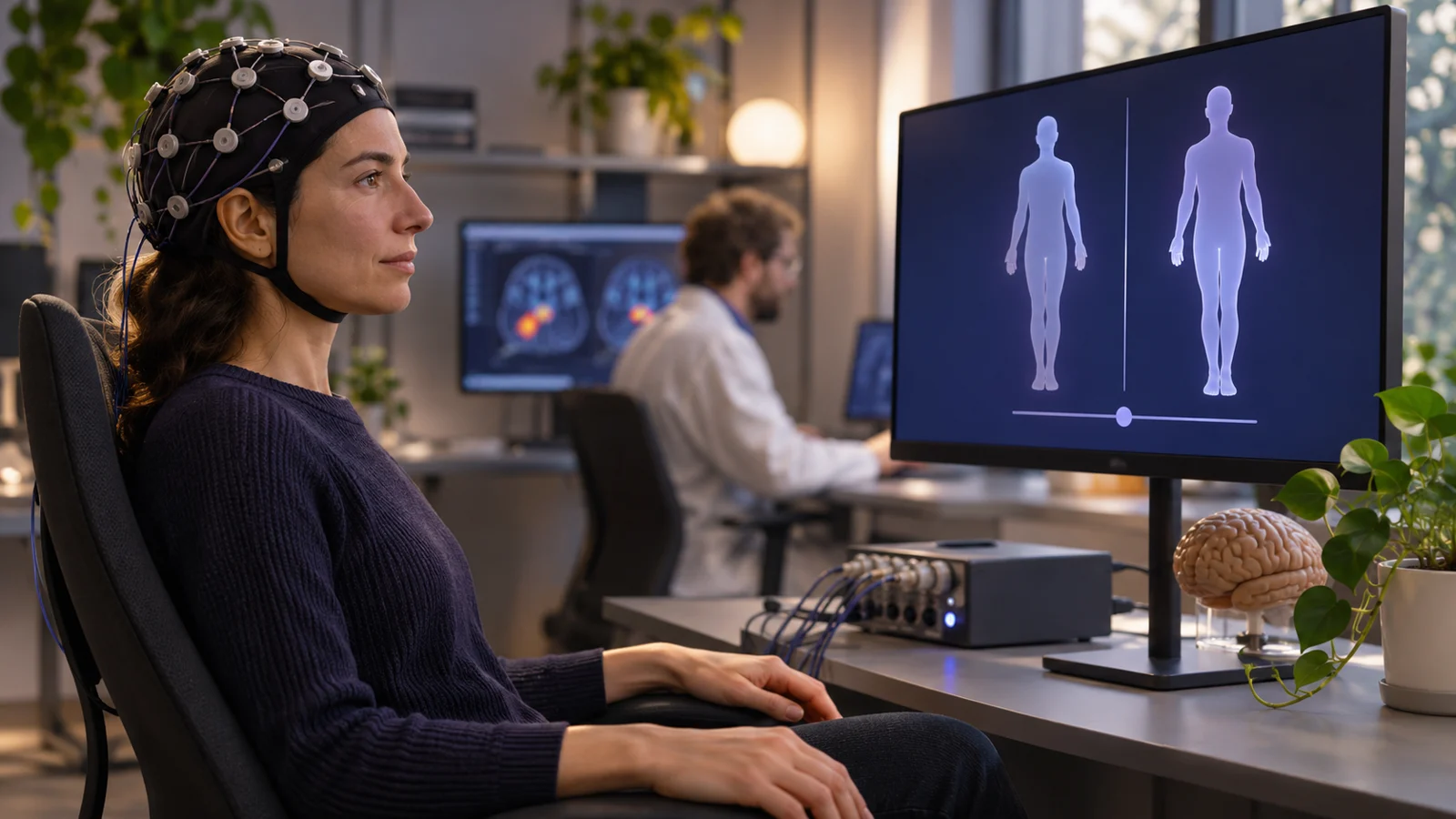
An out-of-body experience can feel direct, coherent and more vivid than an ordinary dream. Its defining feature is not simply an unusual image. It is a change in where the self seems to be located: awareness appears to occupy a position beyond the physical body, sometimes with a view of the body from elsewhere. Neuroscience can investigate parts of that experience without deciding its ultimate spiritual meaning.
The useful scientific question is not “did nothing happen?” It is “which processes are necessary for a stable sense of being here, inside this body, looking from this point?” That approach takes the report seriously while keeping explanation separate from interpretation. For a precise definition, see out-of-body experience and how it relates to astral projection.
The question science can test
A laboratory cannot directly inspect another person's point of view. It can record when the experience occurred, what the participant reported, which sensory signals were changed, what the brain and body were doing, and whether any claimed perception can be checked independently. These measurements let researchers test mechanisms and predictions. They do not turn a private experience into a simple yes-or-no object.
Three claims are often bundled together: a person genuinely experienced being outside the body; the experience was generated or shaped by a particular brain state; and awareness literally obtained information from beyond the body's senses. The first can be documented as a report. The second can be investigated through neuroscience. The third requires controlled information tests. Evidence for one is not automatically evidence for the others.
How the brain models self-location
Ordinary embodiment feels effortless because the brain continually combines vision, touch, proprioception, balance, internal bodily signals and predictions about movement. From that stream it maintains a working model of body ownership, first-person perspective and self-location. The model is normally so reliable that it feels like a fixed fact rather than an active construction.
The temporoparietal junction, or TPJ, is one important part of this network. It sits where temporal and parietal regions meet and participates in combining information relevant to vision, touch, balance and the position of the body. Clinical observations and stimulation studies connect disturbances in this region with autoscopy, altered body shape and apparent displacement. The TPJ appears repeatedly in the research, though it is not an isolated astral projection switch.
Multisensory conflict
In 2007, two research groups showed that carefully timed visual and tactile information could shift where healthy participants felt located. Participants viewed a body or camera perspective while touch on the physical body was matched to what they saw. The resulting full-body illusions did not reproduce every feature of a spontaneous OBE, but they demonstrated that self-location and body ownership can change when normally compatible signals are made to disagree.
This is a mechanism, not a dismissal. Showing that perspective depends on multisensory integration explains why certain conditions may open the experience. It does not settle whether every spontaneous report is exhausted by the laboratory model. A complete account still has to explain why some episodes are brief bodily distortions while others include a stable scene, a narrative and claims about distant information.
Sleep transitions
Many voluntary experiences begin near sleep, especially after an early-morning awakening or during sleep paralysis. At that boundary, the body can be still while imagery, sound and a sense of movement become vivid. REM-related muscle atonia may continue into awareness, and vestibular-motor sensations can produce floating, rolling, rushing or spinning. The physical body has not moved, but the internal movement signal can be compelling.
That makes vestibular sensations especially relevant. The brain must reconcile a quiet bed, reduced external input, an emerging dream scene and a changing body model. A temporary mismatch offers a plausible route from lying down to feeling located elsewhere. It also explains why fear, expectation and sudden attention can reshape the episode.
What laboratory illusions show
Electrical stimulation evidence is often overstated. In the well-known 2002 report, stimulation near the right angular gyrus repeatedly produced altered body perceptions in one patient undergoing epilepsy assessment. Later cases and network studies strengthened the connection between temporoparietal systems and autoscopic phenomena. These are valuable observations, but a small number of clinical cases cannot define a universal cause.
Full-body illusions are controlled analogues rather than complete replicas. They manipulate selected features such as visual perspective, ownership and perceived location. Spontaneous OBEs can include emotion, memory, intense clarity and apparently real environments. A good model should explain those differences instead of treating every unusual embodiment experience as identical.
What remains unexplained
Current evidence supports a layered account. Multisensory integration explains how the ordinary location of the self can become unstable. Sleep science explains why the state is common around REM transitions. Predictive processing explains why expectation and prior experience can help shape an ambiguous scene. None of these, alone, establishes what consciousness ultimately is or whether information can ever be acquired beyond the body's sensory channels.
The strongest position is neither automatic belief nor automatic dismissal. Treat the experience as real as an experience, test claims at the level they are made, and keep competing explanations available. That is the same evidence-first approach used in Is astral projection real?. A mechanism can be well supported while the larger philosophical question remains open.
When to seek medical advice
A brief sleep-related episode in an otherwise healthy person is not automatically a medical emergency. A first episode accompanied by loss of consciousness, injury, seizures, severe headache, weakness, confusion, medication changes or frequent daytime events deserves professional assessment. A scientific approach includes knowing when an unusual experience may have an ordinary health cause that should not be ignored.
Primary research and further reading
Blanke et al., Nature (2002): stimulating illusory own-body perceptions
Ehrsson, Science (2007): experimental induction of out-of-body experiences
Lenggenhager et al., Science (2007): manipulating bodily self-consciousness
Out-of-body experiences, lucid dreaming and sleep paralysis: theoretical review (2024)
Frequently asked questions
Does neuroscience prove that every out-of-body experience is only a brain illusion?
No. It shows that body ownership, perspective and self-location can be altered by multisensory processing. That identifies plausible mechanisms, not a complete explanation of every report.
Can a healthy person have an out-of-body experience?
Yes. Reports occur in healthy people, particularly around sleep transitions, lucid dreams, meditation and extreme stress. New episodes alongside neurological symptoms should be discussed with a clinician.
Why do floating and spinning sensations occur?
The vestibular system helps model balance, movement and orientation. During sleep transitions or sensory conflict, that model can produce vivid movement while the physical body remains still.
Related guides
Do Binaural Beats Help Astral Projection?
Assess binaural beats as an optional relaxation and attention aid, including evidence limits and practical cautions.
What is astral projection?
A precise definition of astral projection, how it differs from dreams and sleep paralysis, and why explanations remain contested.
Is astral projection real?
The experience is real. The harder question is what it represents, and how we could test competing explanations fairly.

Astral projection and sleep paralysis
Why the two states overlap, how to respond to frightening sensations and how to decide whether to continue or wake up.