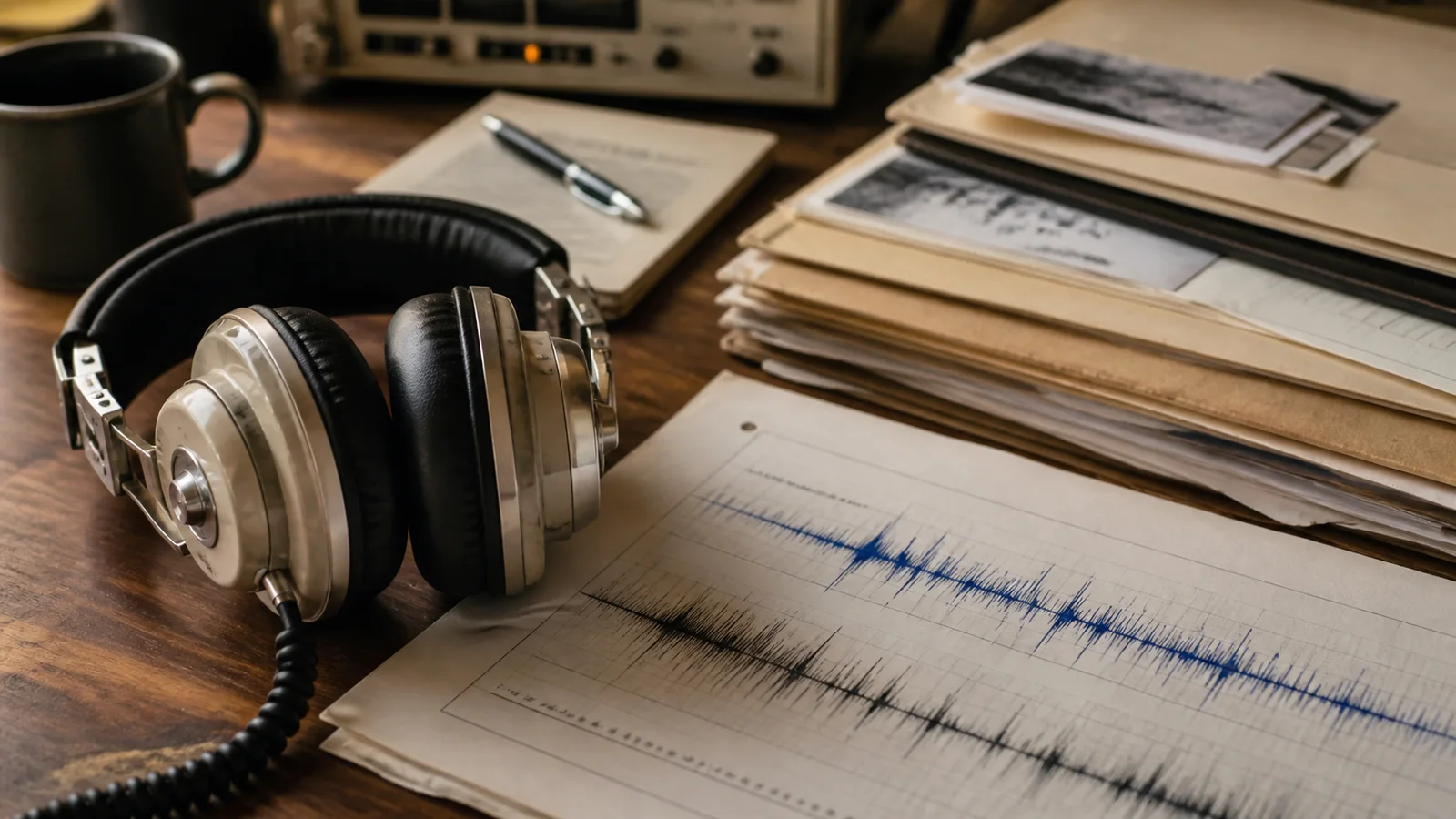
The document is an Army analysis, not a CIA experiment
The claims in the document are separate from controlled evidence; our hidden-target experiment guide explains one way researchers try to test perception claims.
The paper commonly called the CIA Gateway document is titled Analysis and Assessment of Gateway Process. It was written in 1983 by US Army officer Wayne M. McDonnell and later entered the CIA's declassified reading room.
That distinction matters. A document being stored and declassified by the CIA does not mean the agency authored every claim, proved astral projection or officially adopted the paper's model of consciousness.
Gateway was developed by the Monroe Institute
The Gateway Experience used audio exercises, relaxation and focused attention to guide participants through altered states. Robert Monroe's earlier out-of-body experiences and later research shaped the programme and its vocabulary.
The document attempts to explain the method by combining ideas about brain-wave synchronisation, hypnosis, meditation, physics and consciousness. Some passages describe practical training; others move far beyond established evidence.
The paper proposes a broad model of consciousness
McDonnell presents consciousness as energy and treats physical reality as an interacting system of frequencies. He draws on holographic and quantum language to suggest how awareness might access information outside ordinary space and time.
These analogies are not experimental demonstrations. Scientific terms can make a model sound settled even when the links between concepts are speculative. Each claim has to be evaluated on its own evidence.
What remains genuinely interesting
The document shows that altered states and the Gateway programme were taken seriously enough to analyse within a military context. It also preserves a detailed attempt to connect first-person experience, attention training and a theory of consciousness.
That historical interest should not be dismissed. It tells us something about institutional curiosity and the questions being asked. It does not tell us that every answer in the report is correct.
What the document does not prove
It does not provide a controlled demonstration that consciousness leaves the body. It does not show that remote perception was consistently accurate, and it does not turn a speculative physical model into accepted science.
Declassified simply means access restrictions were removed. Governments archive assessments, proposals and disputed ideas as well as verified findings. Provenance is evidence about the document, not proof of its conclusions.
Read it as a source, not a verdict
Separate the paper into history, practical method, reported outcome and theoretical explanation. The historical facts can be checked. The exercises can be tested personally. Outcome claims require controlled evidence, and the theory must stand up to relevant physics and neuroscience.
A careful reading is more interesting than either ridicule or viral certainty. The document belongs in the story of consciousness research, but the story remains unfinished.
A checklist for reading the report critically
Mark whether each passage reports a fact, summarises another source, proposes an analogy or makes a prediction. Check whether cited physics actually supports the conclusion drawn from it. Ask what observation could prove the claim wrong. This prevents the document's confident tone from doing the work that evidence should do.
Also distinguish the Gateway exercises from McDonnell's explanation of them. Relaxation and audio may change attention even if the proposed holographic model is incomplete. A useful technique does not automatically validate the theory attached to it.
Why the document became so persuasive online
The combination of a government archive, missing-page stories, technical language and a subject people already find mysterious is highly shareable. Short videos often compress that context into the claim that the CIA proved manifestation, astral projection or reality itself to be a hologram.
The real document is more nuanced and more interesting. It shows an institution examining an unusual training programme through the concepts available at the time. Reading it carefully strengthens the case for serious investigation because it removes claims the source cannot carry.
The context that viral summaries usually leave out
The 1983 assessment was written at a time of institutional interest in remote viewing, altered states and methods that might have intelligence value. Its author was asked to evaluate the Gateway programme and construct an explanation. The resulting paper synthesises ideas from the Monroe Institute, meditation, hypnosis and speculative interpretations of physics. It is an analytical memorandum, not a peer-reviewed research report with a methods and results section.
The CIA Reading Room is an archive containing material from many sources and with many levels of reliability. A file appearing there establishes provenance and historical interest. It does not mean the CIA originated, endorsed or experimentally confirmed every claim. This is especially important online, where the visual authority of a government document is often used as a substitute for examining how its conclusions were reached.
Separate the exercises from the theory
Gateway exercises use relaxation, attention, guided imagery and audio signals to help participants enter focused states. Those practices can have subjective effects without proving that the universe works exactly as the report proposes. A person can evaluate whether an exercise improves relaxation, imagery or out-of-body transitions while remaining uncertain about holographic analogies and claims of access beyond space and time.
The most useful way to approach Gateway is as a structured practice that generates testable experiences. Keep a record, avoid assuming that every image is external information, and use controlled targets for claims that can be checked. The document is a valuable historical source and a prompt for better experiments. Treating it as a final scientific verdict makes it easier for critics to dismiss the genuinely interesting questions it contains.
Why you should read the original document
Most online claims quote a few pages without the cautious passages, source context or leaps between established facts and speculation. Reading the complete assessment makes those transitions visible. Note which claims come from the Monroe Institute, which are McDonnell's synthesis and which cite other writers. Then compare modern summaries with the words on the page. This simple source check removes several myths while leaving the genuine history and consciousness questions intact.
Frequently asked questions
Did the CIA create the Gateway Process?
No. The programme was developed by the Monroe Institute. The widely shared document was an Army assessment later made available through the CIA Reading Room.
Does the Gateway document prove astral projection is real?
No. It discusses altered states and proposes explanations, but it is not a decisive controlled experiment demonstrating consciousness outside the body.
What is Hemi-Sync?
Hemi-Sync is the Monroe Institute's audio approach intended to support focused states using sound patterns. Claims about its effects should be evaluated separately from the larger metaphysical model.
Related guides

What is astral projection?
A precise definition of astral projection, how it differs from dreams and sleep paralysis, and why explanations remain contested.
Is astral projection real?
The experience is real. The harder question is what it represents, and how we could test competing explanations fairly.

Astral projection vs out-of-body experience
How the terms overlap, why some researchers prefer OBE and when the distinction actually helps.

Astral projection for beginners: what to learn first
A complete beginner route from better sleep recall to a first calm exit attempt, with practical expectations, a seven-day routine and clear safety limits.